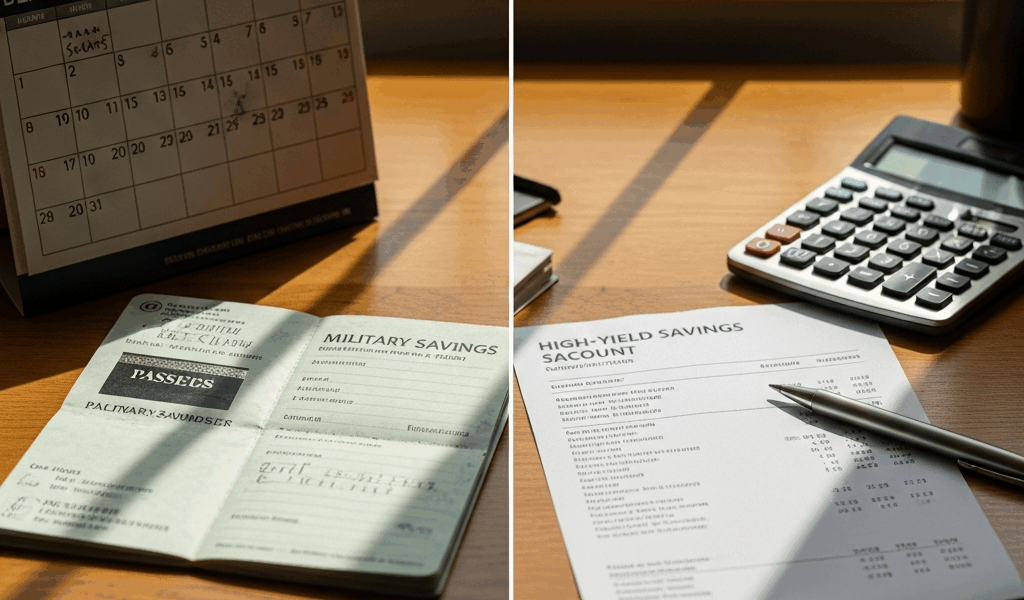
SDP vs High-Yield Savings — Which Beats Both in 2026
Figuring out SDP vs high-yield savings has become exhausting to keep up with all the vague, hedge-everything financial content flying around. As someone who stared at an LES inside a combat zone rotation and had to work through this decision with zero handholding, I learned everything there is to know about how these two accounts actually stack up. Today, I will share it all with you. Short version: the SDP wins — but not universally, and there are conditions worth understanding before you move a single dollar.
What the SDP Actually Is and Who Qualifies
But what is the SDP? In essence, it’s a Department of Defense savings vehicle that pays 10 percent annual interest, guaranteed. But it’s much more than that — it’s arguably the only guaranteed double-digit return available to anyone in 2026, full stop.
The interest compounds monthly. On a $10,000 balance — the hard cap, by the way, not a soft limit — you’re looking at roughly $833 over a full year. More if the deployment runs long and the compounding cycles stack. The cap is firm. Hit $10,000 in contributions and the account stops accepting deposits, period.
Eligibility is strict. You must be serving in a designated combat zone as defined under 26 U.S.C. § 112 — not just deployed, not just overseas somewhere inconvenient. A designated combat zone. You also need at least 30 consecutive days in that zone, or a hospitalization directly resulting from service there. That 30-day clock catches people. Rotating through on short stints? You may not qualify at all.
Contributions have to start while you’re still in the combat zone. After you leave, there’s a 90-day window before the account closes and funds get returned. That detail is buried in fine print everywhere — and it matters when you’re trying to plan around the interest schedule.
Quick note before I keep going. If you don’t qualify, none of the SDP math applies and you can skip straight down to the HYSA section.
How High-Yield Savings Accounts Compare Right Now
Frustrated by the mess of conflicting rate quotes online, I spent an afternoon pulling actual numbers from institutions people actually use. As of early 2026, Marcus by Goldman Sachs sits around 4.10 percent APY. Ally Bank is at approximately 4.00 percent. SoFi advertises 4.20 percent — at least if you have direct deposit set up, which comes with its own conditions attached.
Those are real rates. They’re also variable. In 2023, some of these accounts were pushing 5.25 percent APY. They’ve drifted down since the Federal Reserve started cutting, and there’s no floor guaranteeing they won’t drop further.
What HYSAs offer is flexibility. No eligibility requirements, no contribution caps, no combat zone paperwork. FDIC insured up to $250,000 per depositor per institution. You can move money in and out without penalty. If you have $40,000 sitting in savings, a HYSA will take all of it. The SDP won’t touch a dollar above $10,000.
Tax treatment is standard — interest earned is taxable as ordinary income in the year it’s received. Stateside or deployed, that applies either way.
Side-by-Side Comparison Table
Here’s the direct comparison. No softening, no spin.
| Category | SDP | High-Yield Savings Account |
|---|---|---|
| Annual Rate | 10% guaranteed, compounded monthly | ~4.00–4.20% APY, variable |
| Contribution Limit | $10,000 maximum total | No cap (FDIC limit applies per institution) |
| Eligibility Requirement | Must be in designated combat zone 30+ consecutive days | None — open to any U.S. resident |
| Tax Treatment | Interest may be excludable from gross income if earned in a combat zone | Taxable as ordinary income |
| Liquidity During Deployment | Limited — funds held until deployment ends or 90-day window closes | Full liquidity, withdraw anytime |
| What Happens After Deployment | Account closes within 90 days, funds returned with interest | Account stays open indefinitely |
The SDP’s weaknesses are real. Limited liquidity during deployment means zero access if an emergency surfaces back home. The 90-day close-out is a hard stop — you don’t get to leave that money earning 10 percent once you’re back at home station. And the eligibility wall shuts out a meaningful portion of the military entirely. That’s what makes the HYSA endearing to us service members who don’t hit every qualifying checkbox.
When SDP Wins and When It Does Not
SDP wins decisively for any service member who qualifies and can max the $10,000 cap. A 10 percent guaranteed rate does not exist anywhere else in 2026 — not in Treasuries, not in CDs, not in any FDIC-insured product available to the general public. Nothing comes close.
The more interesting scenario is the service member who qualifies but can’t hit $10,000. Max whatever you can get in — even $3,000 at 10 percent guaranteed beats $3,000 in a 4.10 percent HYSA by a margin that isn’t close. Then route overflow savings into a HYSA. Both accounts can run simultaneously. That’s the right move when you have savings beyond the SDP cap.
SDP loses entirely in one scenario: you don’t qualify. Non-combat-zone deployments, stateside assignments, Guard and Reserve members not activated to a qualifying zone — in those situations, a HYSA at 4.00 to 4.20 percent is a legitimate and solid option. Not a consolation prize. At $50,000 in savings, 4.10 percent returns $2,050 in a year. That’s real money.
I’m apparently someone who ignored the tax angle early on and Ally Bank works for me now while that oversight never fully fixed itself in year one. Don’t make my mistake. SDP interest earned during a combat zone tax exclusion period may not be included in gross income at all — meaning the effective yield climbs well above the stated 10 percent for many service members. Check with your installation’s tax office or a VITA site before filing.
The Move Most Deployed Troops Miss
So The full play, in order:
- Max the SDP at $10,000 if you’re eligible. Do this first — before anything else gets a dollar.
- Open a HYSA — Ally, Marcus, or SoFi all work — and route savings beyond $10,000 there while deployed.
- Review your TSP contribution rate. Combat zone pay that qualifies for tax exclusion can go into TSP potentially tax-free, stacking a second tax advantage directly on top of the SDP benefit.
While you won’t need a financial advisor on retainer, you will need a handful of resources — your unit’s finance office, a MyPay login, and ideally a VITA appointment before tax season. First, you should get the SDP enrollment form started — at least if you’ve confirmed you meet the 30-day combat zone requirement.
Most people pick one account and ignore the rest. The deployed service member who stacks all three — SDP maxed, HYSA absorbing the overflow, TSP contributions adjusted for combat zone exclusions — is playing a completely different game than someone letting pay accumulate in a checking account at 0.01 percent.
The TSP combat zone contribution angle connects directly to limits and tax treatment covered in the TSP guide on this site. Worth reading before your next contribution election cycle. Start with the SDP enrollment form through finance or MyPay. That’s move one.




Leave a Reply