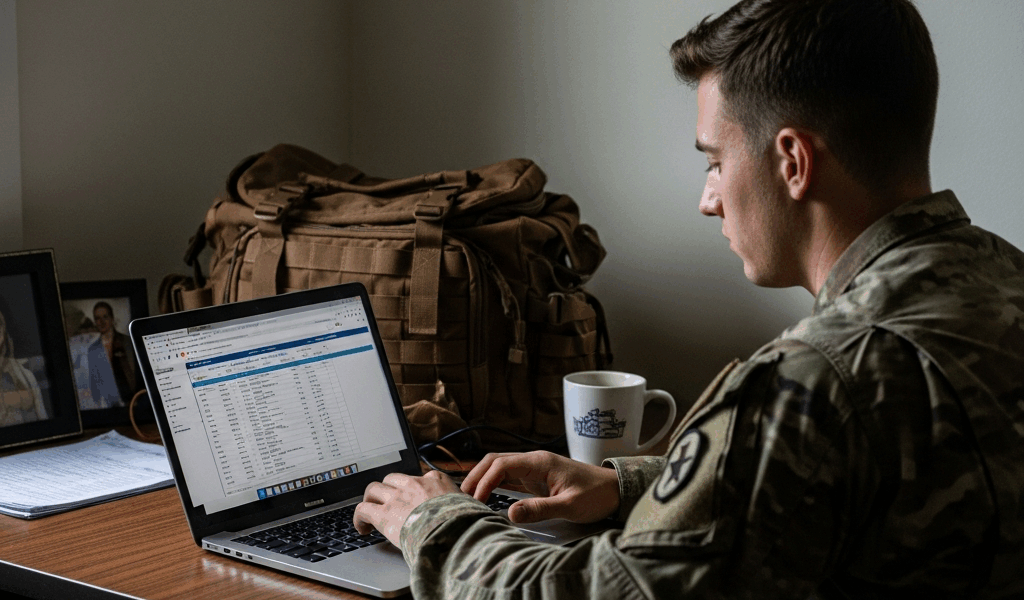
Military Deployment Money Moves — SDP and TSP Guide
As someone who served through multiple combat rotations, I learned everything there is to know about deployment finances the hard way — meaning I nearly blew past the Savings Deposit Program entirely during my first one. Three weeks in, a finance sergeant pulled me aside and asked if I’d enrolled. I hadn’t. I lost almost a full month of 10% guaranteed returns because nobody handed me a pamphlet at the airport. Don’t make my mistake. This guide is the unified playbook I wish I’d had — covering both the Savings Deposit Program and the Thrift Savings Plan together, because separating them into two different conversations is exactly how service members end up leaving money on the table.
This article includes affiliate links. We may earn a commission at no extra cost to you.
SDP — The 10% Guaranteed Return
But what is the Savings Deposit Program? In essence, it’s a government-backed account paying 10% annual interest — not a typo — on deposits up to $10,000 while you’re serving in a designated combat zone. But it’s much more than that. In a world where a “high-yield” savings account brags about 4.5%, the SDP is almost embarrassingly good. Compounds quarterly. Government-backed. And most people in uniform have never heard of it.
Enrollment has a few quirks worth knowing. You have to show up in person to your deployed finance office — this isn’t something you configure through myPay sitting on a cot at 2 a.m. Bring your military ID and banking information. The minimum deposit is $5. The maximum cumulative deposit is $10,000. You can make deposits incrementally throughout the deployment, which matters for the month-by-month strategy below. Setting up automatic allotments from your regular pay to feed the SDP is honestly the move — do it the first week you land, full stop.
One thing that trips people up — the 10% is annualized. Six-month deployment? You’re earning roughly 5% on whatever you’ve deposited, not a flat 10% payout at the end. Still phenomenal. Still better than almost anything a civilian investor with no risk tolerance can touch. Just understand the math before you start doing mental gymnastics about projected returns.
The 90-day post-deployment window is critical, and it gets its own section later. For now, just know the account doesn’t slam shut the second you step off the plane at home station. You have time to be strategic about the exit.
TSP in a Combat Zone — Tax-Free Growth
I should’ve put this up front, my bad., because the TSP combat zone benefit is something even financially-aware service members often don’t fully grasp. Here’s the headline: contributions you make to your Roth TSP from combat zone pay go in tax-free, grow tax-free, and come out tax-free in retirement. That’s triple tax-free treatment on money that wasn’t being taxed at the source to begin with.
Combat zone compensation is excluded from federal income tax under 26 U.S. Code § 112. When you funnel that excluded income into a Roth TSP, it never gets taxed at any point in its entire existence. The traditional TSP math works differently — contributions from excluded pay don’t get taxed going in, but distributions in retirement are taxed normally. The Roth is almost always the right call for combat zone contributions. That’s what makes the Roth TSP endearing to us deployed service members — the math just works in our favor in a way it rarely does elsewhere.
On contribution limits: the standard elective deferral limit for TSP sits at $23,000 in 2024. Service members in a combat zone, though, can contribute up to the IRS Section 415(c) limit — $69,000 in 2024. That’s the total additions ceiling, inclusive of contributions plus any agency matching under BRS. Most enlisted members won’t come close to maxing that. But the ceiling is high enough that it won’t limit any realistic deployment savings strategy.
Frustrated by leaving tax-free growth on the table during a deployment to eastern Afghanistan in 2019, a staff sergeant I knew maxed out her Roth TSP using nothing but pre-planned BAH and BAS suspensions — packing $23,000 into a Roth that year with zero federal tax liability on any of it. She didn’t do anything exotic. She just knew the rules and acted on them in week one.
To bump your TSP contribution rate, log into MyPay or the TSP website directly. Changes typically take one to two pay periods to show up. Do this early. Every pay period you delay is a missed window you genuinely cannot recover.
Month-by-Month Deployment Savings Plan
Let’s build an actual example. Take an E-5 with four years of service deploying to a combat zone for nine months in 2024. Base pay runs roughly $3,110 per month. Add Hostile Fire Pay ($225/month) and Family Separation Allowance ($250/month if applicable), then layer in the tax exclusion — suddenly the monthly take-home math shifts in a meaningful way. No federal income tax. That’s real money staying in your pocket each month that normally wouldn’t.
Month 1 — Foundation First
Month one is setup month, nothing more. Enroll in SDP at the finance office within the first week — seriously, put it on the calendar for day three or four. Drop an initial $500 to $1,000 deposit to get the account open and earning. Bump Roth TSP contributions to at least 15% of base pay if they aren’t already there. If there’s existing high-interest debt — credit cards, personal loans sitting above 7% — throw one extra lump payment at those before locking money away in anything. Emergency fund should have at least $2,000 sitting liquid back home. The USAA Performance First savings account was paying around 4.25% APR as of mid-2024, which works fine for that purpose.
Months 2 through 6 — Stack the SDP
Each month, contribute enough to the SDP to hit the $10,000 cap before the deployment ends. Spread over nine months, that’s roughly $1,111 per month. Round up to $1,200 monthly — you’ll hit the cap by month eight with a small buffer built in. Keep Roth TSP contributions running in parallel the entire time. The goal isn’t to choose between SDP and TSP. The goal is running both simultaneously, treating them as two vehicles doing two completely different jobs.
SDP is your guaranteed, risk-free, short-to-medium-term vehicle. TSP is your long-horizon, tax-advantaged retirement vehicle. They don’t compete. They complement each other — and that’s the part most guides miss by splitting them into separate conversations.
Months 7 through 9 — Refinement
By month seven, the SDP should be fully loaded or close to it. Redirect that monthly SDP allotment into either additional TSP contributions or the home-station savings account. Start thinking about the 90-day exit window — not panicking about it, just thinking. Research the options before you’re standing on the tarmac at home station making financial decisions on four hours of sleep.
Over a nine-month deployment, this E-5 could realistically walk away with $10,000 in SDP — earning approximately $750 in guaranteed interest over the deployment period — plus $4,000 to $6,000 in additional Roth TSP contributions stacked on top of whatever normal contributions were already running. That’s a meaningful difference in lifetime wealth trajectory from a single deployment.
The 90-Day Window After Deployment
The SDP doesn’t stop earning when you redeploy. That’s the part that surprises people every single time. The account keeps earning 10% annual interest for up to 90 days after you leave the combat zone — or until you make a withdrawal, whichever comes first. It’s a grace period, deliberately designed to keep service members from making panicked financial decisions the moment they hit the tarmac.
Here’s the practical reality of what that window actually looks like. You have 90 days to decide where $10,000-plus is going. Don’t let reintegration chaos make that decision for you. Spouses who’ve been managing the household alone for nine months, kids who want new bikes, a truck with 180,000 miles that apparently needs everything replaced at once — none of that should vacuum the SDP account dry in week one. The money keeps earning. Let it sit.
When you do withdraw, the options break into a few clean categories. No high-interest debt? The SDP proceeds should move toward one of three places: a high-yield savings account to rebuild or pad the emergency fund, a Roth IRA if you haven’t hit the $7,000 annual limit yet (Fidelity and Vanguard both work fine for this), or toward a real estate down payment if that’s already in the plan. What it should not do is sit in a regular checking account at 0.01% APR for six months because you never got around to moving it.
Timing the withdrawal within that 90-day window matters more than people think. If you’re a few days out from a quarterly interest credit, wait for it. A $25 or $40 credit takes four days of patience. That’s a reasonable trade by any measure.
The TSP side doesn’t require the same urgency post-deployment. Reset your contribution rate back to something sustainable on a stateside paycheck — most people land somewhere between 10% and 15% — and let the Roth account compound quietly in the background. The contributions you made from combat zone pay are in there, untouchable by federal tax, growing until retirement. That’s the part that lasts long after the deployment patch comes off.
Deployment is temporary. The financial decisions you make during it aren’t. The service members who come out ahead aren’t running complicated strategies — they’re the ones who enrolled in SDP in week one, kept the Roth TSP running the whole time, and didn’t spend the 90-day window on a truck they didn’t need.



Leave a Reply